Inlet Devices for Separator Vessels
05 | 06 | 2026
6 visualizações
Separator vessels are phase segregation units common to numerous steps in different processes. They are particularly one of the main pillars of upstream stages, which, among other functions, are intended for transporting the extracted oil to the refineries. This is because they ensure that the compression system operates free of liquids and that the technical specifications for BS&W (Basic Sediments and Water) and PW (Produced Water) are met.
These are horizontal or vertical vessels installed in both onshore stations and offshore platforms, and can first be classified according to the type of separation they must perform, such as Gas-Liquid, Liquid-Liquid, or Gas-Liquid-Liquid separation, the latter in situations where immiscible liquids are simultaneously present. Another common classification is according to their operating pressure, which can be low (commonly between 0.7 and 12 bar), medium (commonly between 15 and 48 bar), and high (commonly between 65 and 103 bar).
To meet their objectives, separators must be suited to handle various secondary effects that contribute to the complexity of their design. The gases must meet minimum liquid content, the oil must have controlled water traces, and vice versa. But to meet these requirements, the separator must also be able to handle solids content (sand), emulsions, and foam formation, among others.
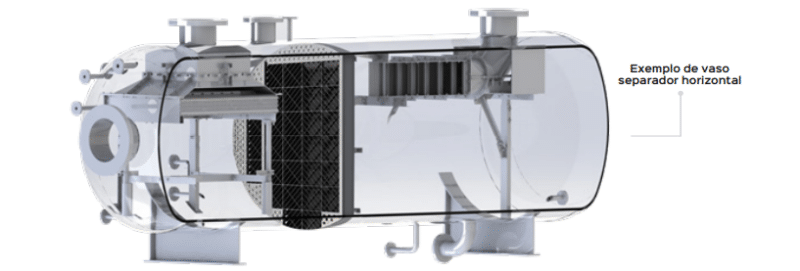
One of the most fundamental points for the performance of separator vessels is the inlet devices, which are often neglected. The inlet of these vessels can substantially affect their performance. Therefore, experience and expertise in design, appropriate internal selection, and a series of best practices and precautions must be followed and managed so that the separator operates with the required success.
In sizing separator vessels, whether for gas-liquid, liquid-liquid, or gas-liquid-liquid operations, it is necessary to determine which phases are dispersed and what the minimum droplet diameter to be separated is. These cut diameters are successfully calculated using Stokes and Souders-Brown equations, along with the efficiency sizing of the separation internals.
The function of a fluid inlet device is to reduce its inlet momentum into the vessel. The initial momentum is calculated by multiplying the mixture density by the square of its inlet velocity. The higher this value, the greater the effect of the fluid’s interaction with the bodies present inside the vessel.
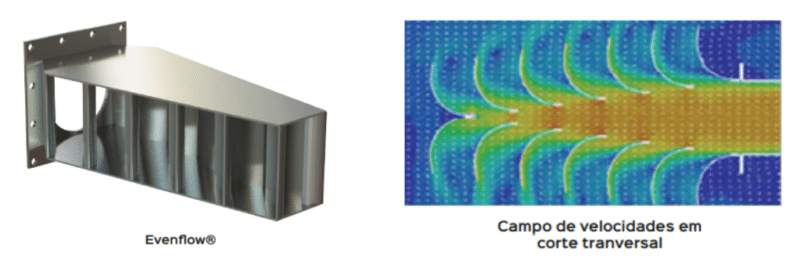
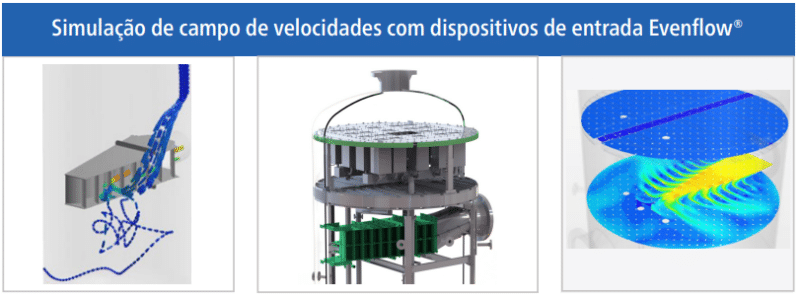
The Flow Direction Pattern is fundamental in determining whether the fluid reaches the demisters and coalescers uniformly. Uniform velocities in the separation equipment are one of the factors that ensure expected performance. Reducing the inlet speed of the mixture into the vessel brings two major benefits:
- Allows for phase pre-separation, reducing the load to be handled by the separator vessel;
• Helps in distributing arrival velocities to the separation equipment.
Poor inlet distribution is an effect that can be minimized or even eliminated with the use of an inlet device.
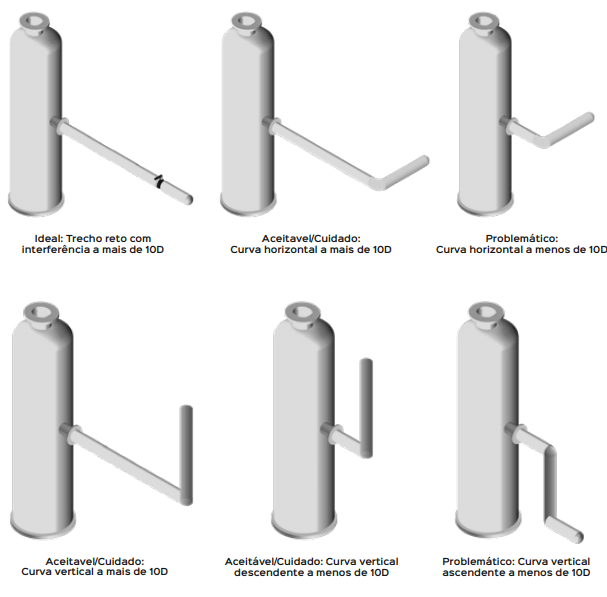
This poor distribution occurs because the obstacles in the feed piping of the vessel influence the two-phase flow pattern that feeds it, causing a distortion in its velocity distribution and flow regime.
Good engineering practices suggest the use of 10 pipe diameters of straight run before the vessel inlet.
But this is not always possible. Inlet devices should be especially considered in cases where layout interferences exist, particularly for situations that require care or that would be unacceptable in terms of separator vessel efficiency, as described below.
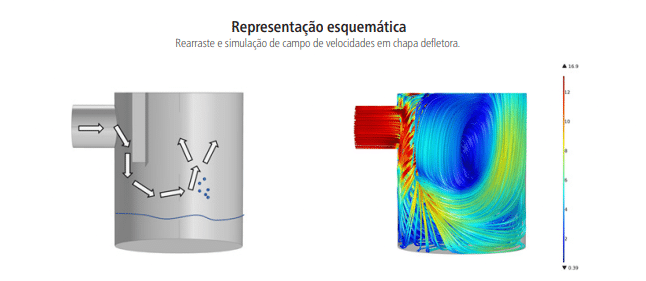
Droplet Shearing, as mentioned, occurs when, due to high inlet speed and momentum, the fluid strikes the vessel walls forcefully, causing the droplets to shear and reduce in size, which can modify the parameters for which the vessel was designed, making separation more difficult.
Moreover, the inlet device must be carefully designed, as simpler mechanisms, such as baffle plates, also have associated problems, such as Re-entrainment.
Re-entrainment is understood as any carryover of liquid already collected.
Baffle plates redirect the incoming gas flow to the bottom of the vessels, but there are cases where the momentum reduction is not sufficient, and the fluid is redirected to a region where there is a retained liquid level, potentially suspending droplets through the interaction between the incoming flow and this liquid interface.
Clark Solutions has extensive experience in the selection, sizing, design, and simulation of Inlet Devices and can assist and provide the most suitable solutions tailored to the intended process and operation, offering cyclonic, finned, tangential, and various other types, with its EvenFlow®, FoamBreaker®, and VaporHorn technologies.
To be fixed to the vessel, the devices, as well as other internals sized and designed by Clark Solutions, use a non-welded support system, designed to position all internals using only mechanical locks, eliminating any need for welding. They can be sized for any vessel and installed through the manhole.
This brings several advantages, by allowing shorter shutdown time for internal replacements, and eliminating the need for area isolation and vessel re-certification for NR-13 due to welding, which is eliminated by the internal locking system.